The brief I gave myself: produce a campaign grade package for a spec running spot without booking a single thing. No talent, no studio, no camera. If it works, it proves something I think every production company is about to care about very much. The craft of a photoshoot, casting, wardrobe, lighting, coverage, survives the shoot itself disappearing.
Meet Mei. She is 26, an elite distance runner, and she does not exist.
Casting a person who isn't there
The instinct with AI imagery is to chase the single perfect frame. That instinct is the enemy. A campaign needs the same face in frame after frame, and that means the job is not prompting, it is casting. So I ran it like a casting session: one locked character description, six rolls, each in a fresh session so no face could contaminate the next. Six candidates came back, and they went on a sheet like any other casting day.
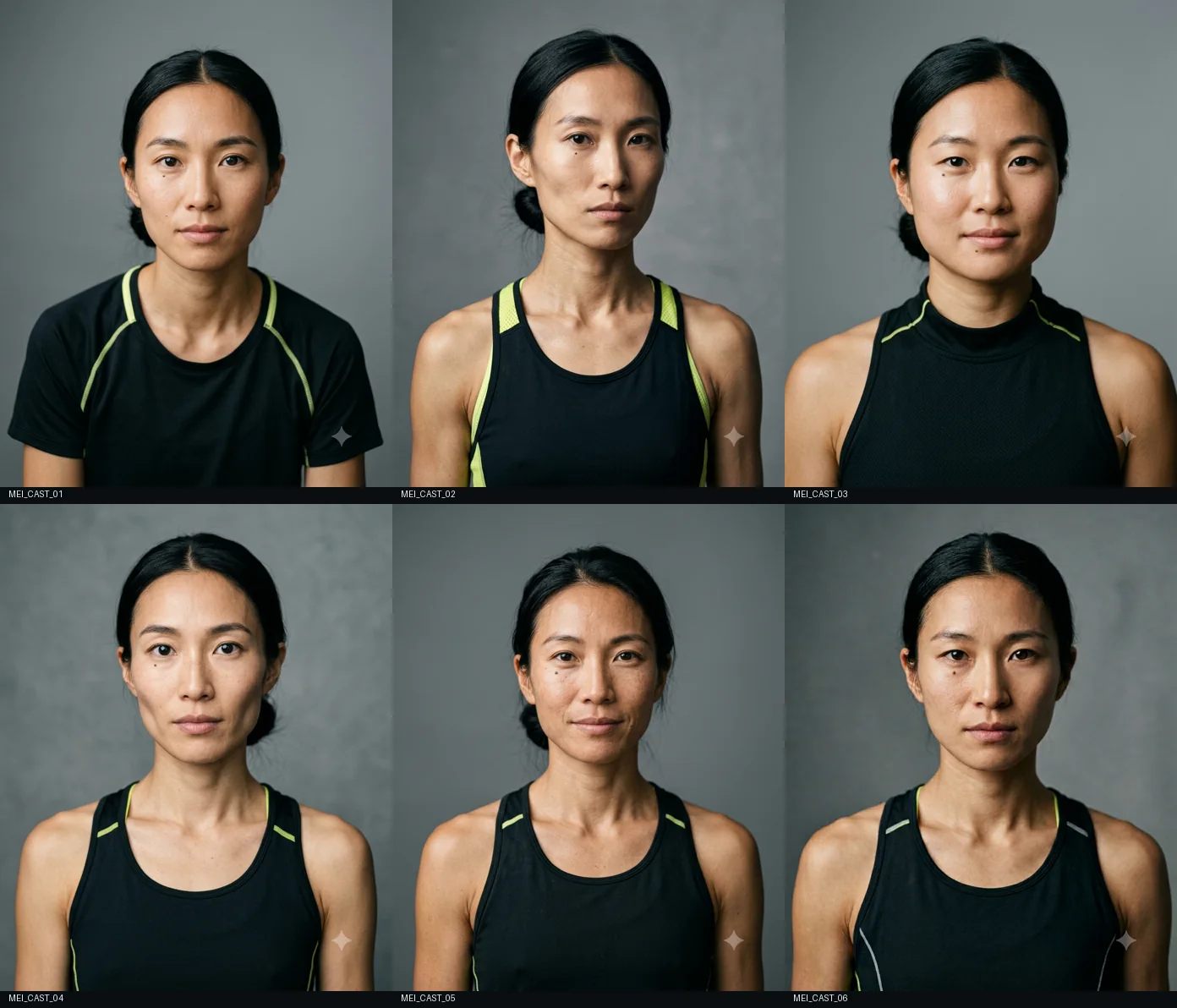
Every one of them technically matches the written description. None of them are the same person. That gap between "matches the description" and "is her" is exactly the gap between prompting and producing, and picking the plate felt like every casting decision I have ever sat in, argued instincts, no formula.
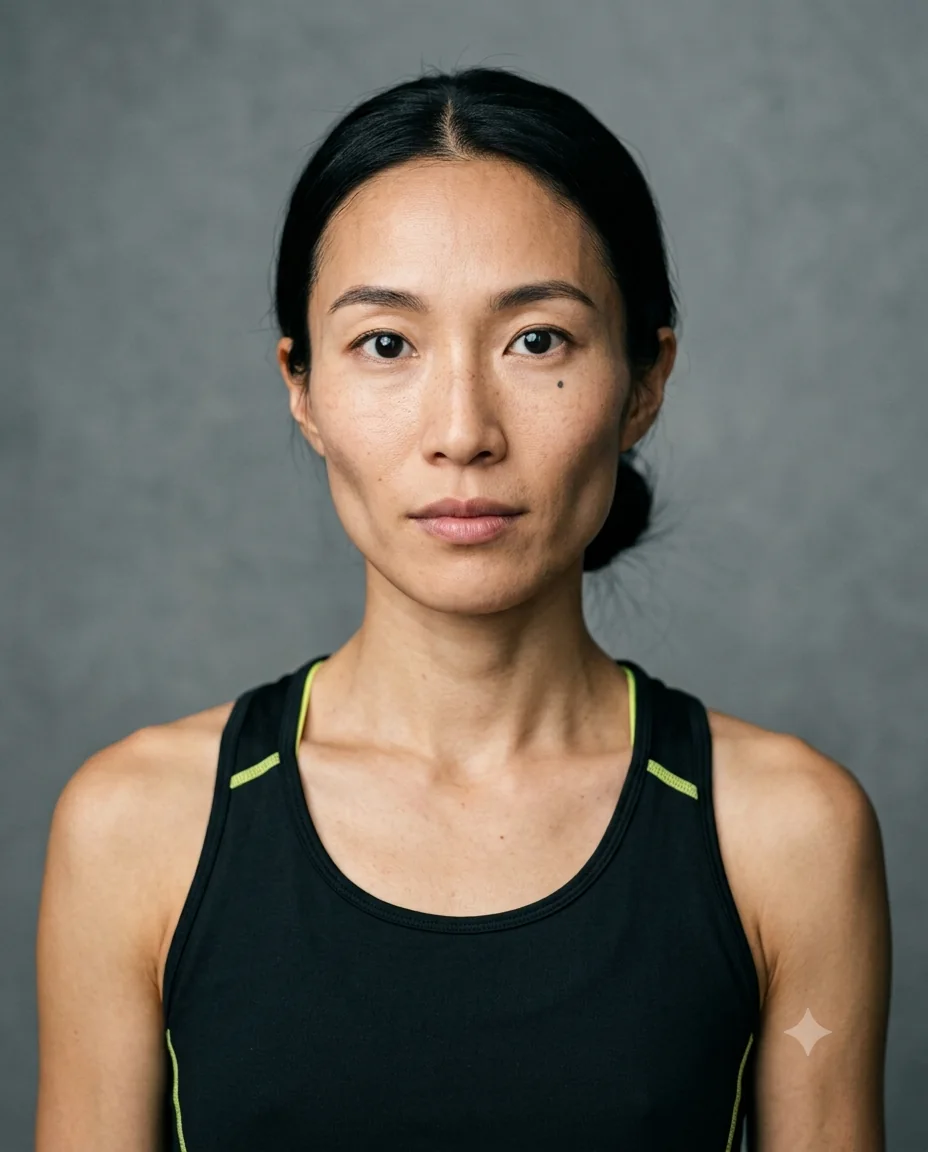
The consistency system is deliberately boring, and that is why it works. A short identity block that never changes, word for word, in every prompt. And a set of anchors checked in priority order on every frame: the beauty mark under her left eye is the canary, first thing to drift. Then the low bun. Then the kit, matte black with volt accents, no logos. Treat the character like a licensed asset with a style guide and the tools respect it. Treat her like a prompt and she dissolves.
The turnaround
Before any hero shots, the model kit pass: six angles, frozen light, frozen wardrobe, full figure. The same discipline as shooting a car or a product. This board is the proof of identity, and it becomes the reference geometry everything else leans on.
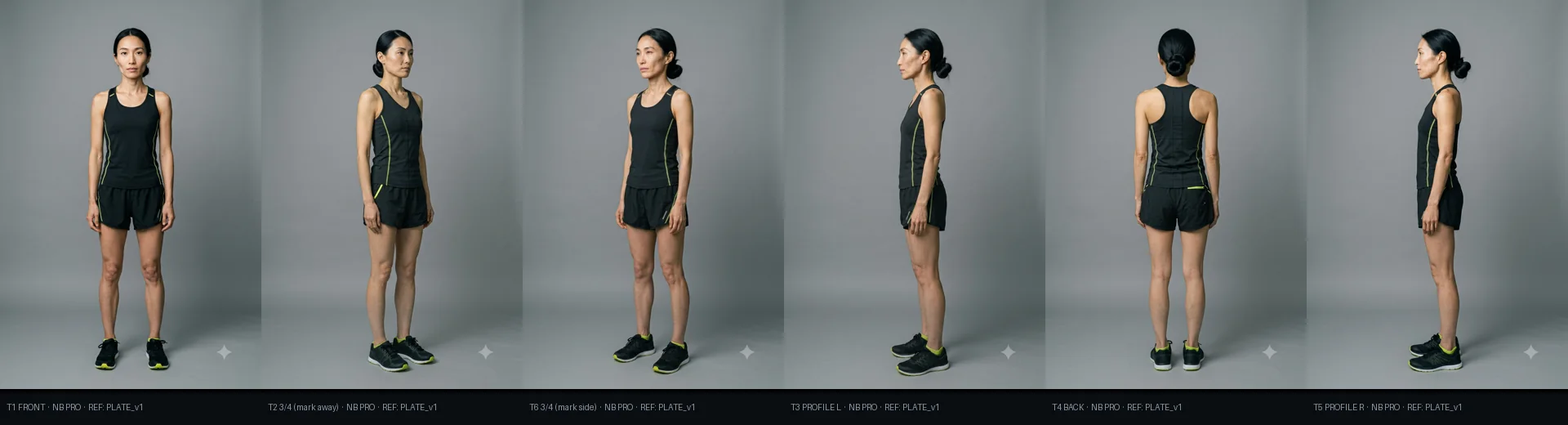
The working rule that saved the day more than once: when an angle drifts, the fix is more reference, not more words. Attach the plate plus the best already approved angle and ask again. Explaining harder never worked. Showing more always did. Twenty years of producing in one sentence, honestly.
Keeping the misses
Field notes that only show wins are advertising. Here is the day's best fail: the three quarter left angle came back as a second three quarter right, a mirror of a shot I already had. The model cannot hear "your other left" any better than the rest of us on set.
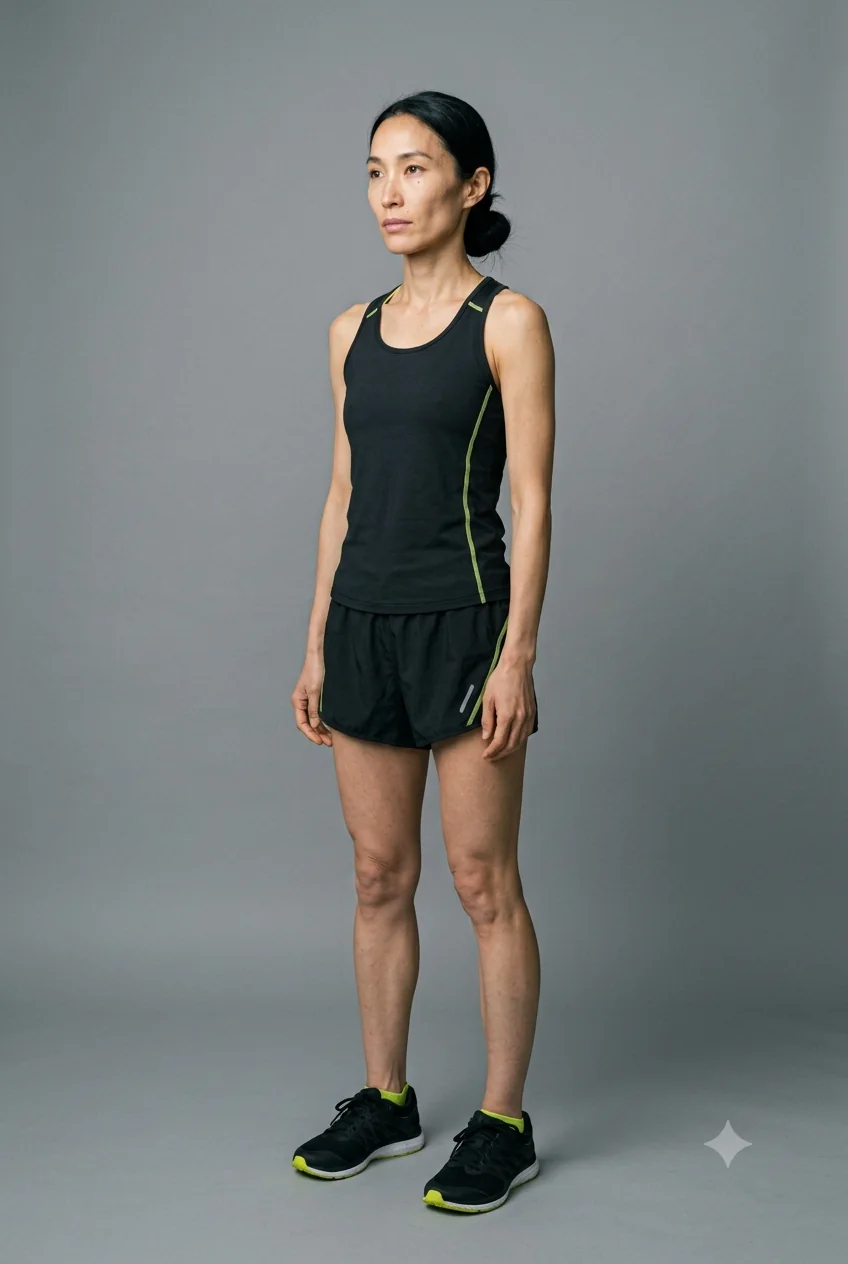
Everything gets logged in a manifest, keepers, retries, fails, which references were attached to which roll. That paper trail is not admin. It is the whole reason frame forty can match frame one.
What happens next
Part two is the shot pack: ten frames of running spot coverage, pre dawn stretch to product beauty, generated in volume on a local rig I run on my own GPU, with the motion pass after that. The plate and this turnaround are the DNA for all of it. If the face holds at frame forty like it held at frame six, the thesis holds with it.
Toolchain so far: Nano Banana Pro for casting and turnaround, a local ComfyUI/FLUX rig queued for volume stills, Kling 3.0 for the motion pass, After Effects for finish. Directed the old way: one identity, one look, no drift tolerated.